
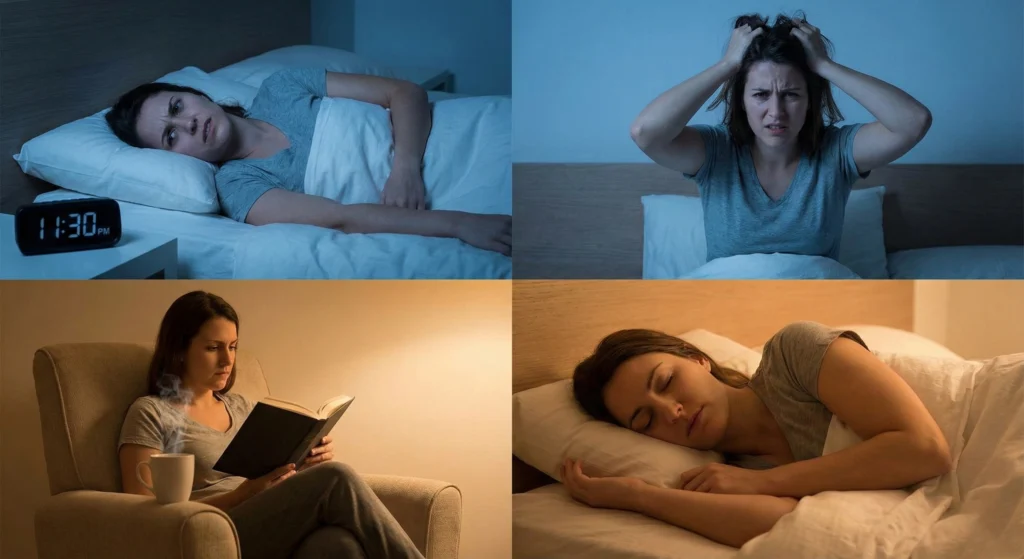
Many people approach sleep as something they should be able to do on command.
You lie down.
You close your eyes.
You expect sleep to follow.
But when it doesn’t, frustration builds — and that frustration itself becomes another barrier to rest.
The truth is simple, but often overlooked:
sleep can only begin after relaxation has already happened.
Sleep Is Not the Same as Relaxation
Sleep and relaxation are closely related, but they are not interchangeable.
Relaxation is a process.
Sleep is a result.
You can be lying still and still not be relaxed.
You can be exhausted and still not be calm.
This is why so many people feel:
- physically tired but mentally alert
- tense even while resting
- more aware of discomfort at night
Without relaxation, sleep has nothing to build on.
The Nervous System Needs Permission to Rest
Your nervous system does not respond to intention — it responds to signals.
Throughout the day, it receives constant cues to stay alert:
- deadlines
- screens
- conversations
- physical tension
- background stress
By the time night arrives, your body may still be operating in a heightened state, even if your mind wants to sleep.
Relaxation is what signals permission to shift out of that state.
Until those signals are received, sleep remains out of reach.
Why Lying Down Isn’t Enough
Many people assume that getting into bed equals relaxation.
But the body doesn’t automatically relax just because it’s horizontal.
Muscles can remain subtly contracted.
Breathing can stay shallow.
The jaw, neck, and shoulders may still hold the day’s tension.
At night, when external distractions fade, the body becomes more noticeable —
and so does unresolved tension.
This is why relaxation must be intentional, even if it is gentle and effortless.
What Relaxation Before Sleep Actually Looks Like
Relaxation before sleep is not about “trying to relax.”
It’s about creating conditions that allow relaxation to emerge naturally.
This may include:
- slowing the pace of the evening
- reducing sensory input
- allowing repetitive, calming activities
- supporting the body as it releases tension
The key is consistency, not intensity.
Small signals, repeated nightly, teach the body that it is safe to let go.
When Relaxation Comes First, Sleep Follows More Easily
When relaxation is present, several things begin to change:
- breathing becomes deeper
- muscle tension softens
- mental activity slows
- awareness becomes less effortful
Sleep doesn’t need to be chased at this point.
It begins to arrive on its own.
This is why routines that focus on relaxation first —
rather than sleep itself — tend to be more sustainable over time.
A Gentler Approach to Better Sleep
If sleep has been difficult, it’s tempting to search for stronger solutions.
But often, what’s missing isn’t more effort —
it’s more permission for the body to unwind.
Relaxation is not a luxury or an optional step.
It is the foundation on which sleep is built.
Once that foundation is in place,
sleep has far less resistance to overcome.
Closing Thought
You don’t fall asleep because you decide to.
You fall asleep because your body is ready.
And readiness begins with relaxation —
long before sleep itself begins.