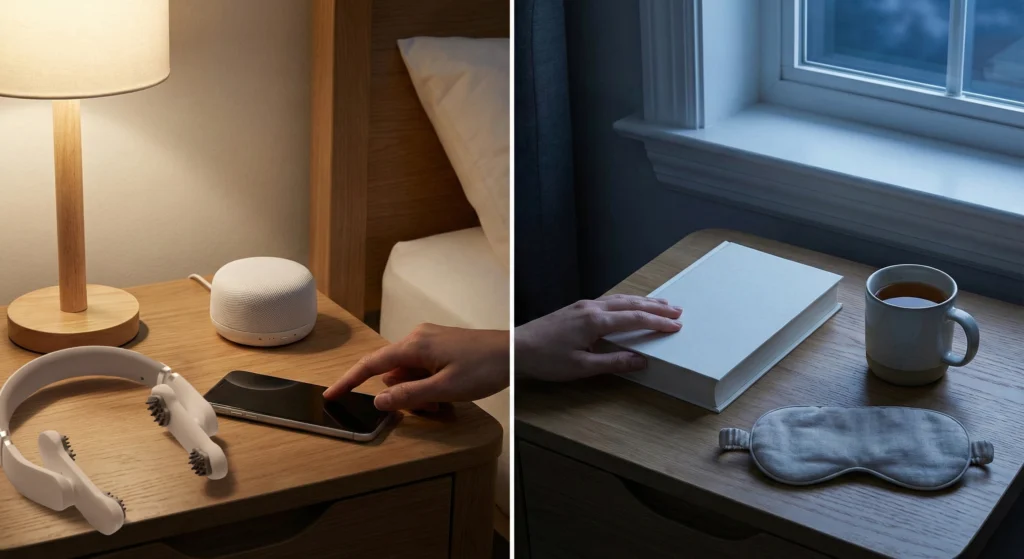
As conversations around sleep evolve, more people are encountering the term sleep-tech.
But the meaning of sleep-tech is often misunderstood — and sometimes overstated.
To understand its real value, it helps to be clear about what sleep-tech actually is — and what it isn’t.
Sleep-Tech Is Not About Forcing Sleep
Sleep-tech is not designed to make you fall asleep.
It is not:
- a sedative
- a shortcut
- a way to override your body’s natural rhythms
Sleep that is forced rarely lasts.
When the body isn’t ready, sleep becomes light, fragmented, or difficult to sustain.
Effective sleep-tech respects one simple truth:
sleep cannot be commanded — it has to be allowed.
Sleep-Tech Supports the Transition Into Rest
The real role of sleep-tech lives before sleep begins.
It supports the moment when:
- the day is ending
- stimulation is decreasing
- the body is preparing to let go
Rather than triggering sleep directly, sleep-tech helps:
- ease lingering physical tension
- reinforce signals of calm
- make the transition into rest feel smoother
In this way, it becomes part of the wind-down phase — not the sleep itself.
Not Medical Treatment — Not Passive Distraction
Sleep-tech occupies a middle ground.
It is not medical treatment.
It does not diagnose, treat, or cure conditions.
And it is not passive distraction —
something to keep your attention busy until you pass out.
Instead, it belongs alongside:
- evening routines
- relaxation practices
- lifestyle habits that support recovery
Its purpose is not control, but support.
Why “Non-Invasive” Matters
When it comes to rest, subtlety matters.
Non-invasive sleep support works with the body’s nervous system —
not by overwhelming it with stimulation or demand.
Gentle, predictable input is more likely to:
- reduce resistance
- support calm
- feel sustainable over time
Sleep-tech that respects this principle is easier to integrate into daily life —
and easier for the body to accept.
A Lifestyle View of Sleep Support
From a lifestyle perspective, sleep-tech is not about optimization or performance.
It’s about ease.
Ease at the end of the day.
Ease in letting go of tension.
Ease in transitioning from activity into rest.
For people who don’t unwind easily,
this kind of support can make rest feel more accessible — without pressure.
When Sleep-Tech Makes Sense
Sleep-tech is not necessary for everyone.
But it may be helpful for those who:
- struggle to fully relax at night
- feel tension linger even during rest
- want support without medication or force
Used intentionally, sleep-tech becomes part of a nightly rhythm —
not a dependency, not a solution, but a companion to calm.
Closing Thought
Sleep-tech is not about controlling sleep.
It’s about supporting the conditions that allow sleep to happen naturally.
When understood this way,
it becomes less about technology —
and more about how we choose to care for rest in modern life.