
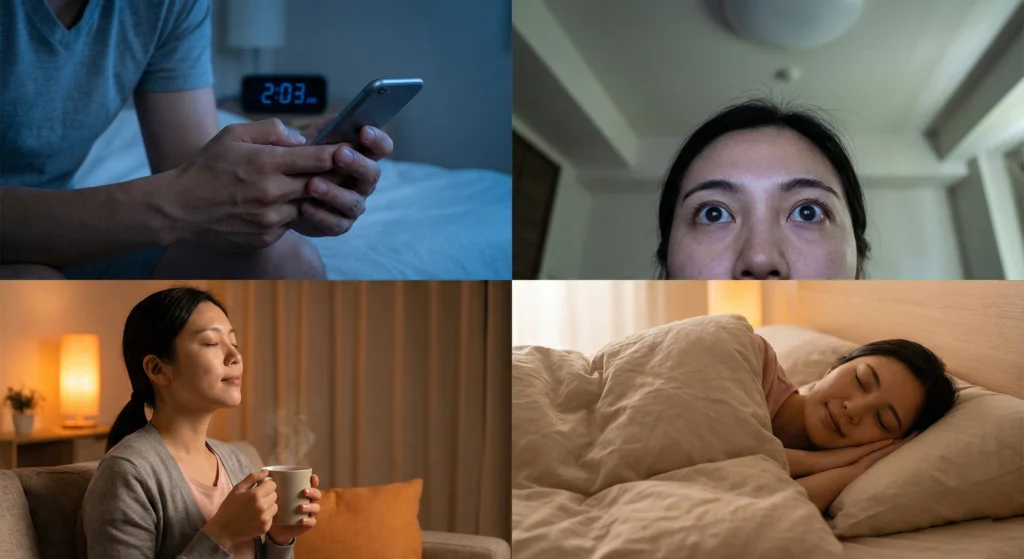
When sleep becomes difficult, people often look for answers in habits, schedules, or routines.
But beneath all of those factors lies something more fundamental:
the state of your nervous system.
Sleep quality is not only about how tired you are —
it’s about whether your nervous system feels safe enough to rest.
The Nervous System Decides When Sleep Is Possible
Your nervous system acts as a constant monitor.
Its job is to assess:
- safety
- threat
- demand
- readiness
As long as it senses the need to stay alert,
sleep will remain light, delayed, or fragmented.
This is why you can feel exhausted and still struggle to sleep.
Fatigue does not automatically equal calm.
A calmer nervous system is what allows the body to fully let go.
Why the Body Stays “On” at Night
Modern life trains the nervous system to stay active:
- constant notifications
- late-night screen exposure
- mental multitasking
- unresolved physical tension
Even when the day ends, these signals don’t immediately stop.
At night, when distractions fade, the nervous system often remains alert —
and the body may feel restless, tense, or unable to settle.
This state is not a failure of sleep.
It’s a sign that the nervous system hasn’t fully downshifted yet.
Calm Is a Physical State, Not a Thought
Many people try to calm themselves mentally:
- telling themselves to relax
- distracting the mind
- forcing stillness
But the nervous system responds primarily to physical signals, not instructions.
Breathing patterns, muscle tension, posture, and sensory input
all play a role in how safe and settled the body feels.
This is why approaches that support the body —
rather than only the mind — tend to be more effective for sleep.
What Changes When the Nervous System Calms
As the nervous system settles, subtle but meaningful shifts occur:
- breathing slows and deepens
- muscle tone softens
- heart rate becomes more regular
- awareness becomes less effortful
These changes don’t force sleep —
they remove the barriers that were preventing it.
Sleep, then, becomes a natural continuation of calm.
Why Some Nights Feel Easier Than Others
You may notice that sleep comes more easily on certain nights:
- after a calm day
- when physical tension is lower
- when your evening feels unrushed
This isn’t random.
Those nights share a common factor:
a nervous system that has already begun to relax.
Understanding this helps shift the focus away from “trying to sleep”
and toward supporting calm earlier in the evening.
Supporting Calm as a Daily Practice
A calmer nervous system is not created in one moment.
It’s shaped by:
- consistent evening signals
- gentle, repeatable routines
- environments that reduce stimulation
- support that helps the body unwind
Over time, these patterns teach the nervous system
that night is a time for rest — not vigilance.
Closing Thought
Better sleep doesn’t start in the bedroom.
It starts with a nervous system that feels ready to rest.
When calm comes first,
sleep no longer has to be chased.